Introduction: A Fertile Ground for Transformation
- Agriculture in India is more than an economic sector – it’s the backbone of food security for 1.4 billion people and a critical pillar of global food systems. Fertilizers sit at the heart of this ecosystem. Since the Green Revolution, they’ve underpinned India’s rise to becoming one of the world’s largest agricultural producers, with grain output touching 330 million tons annually.
- The market outlook reflects this centrality. Multiple forecasts converge on one point: India’s fertilizer sector is set for strong, sustained growth. While discrepancies in figures arise due to scope definitions (core fertilizers vs. broader agri-inputs) and currency adjustments, the story remains consistent: India’s fertilizer industry is on an upward trajectory, propelled by rising food demand, government support, and the shift toward sustainable practices.
- This blog unpacks that growth story – covering market size, structural challenges, innovations in new-age fertilizers, and the strategic implications for policymakers, investors, and farmers.
Market Growth & Size: A Booming Sector with Evolving Dynamics
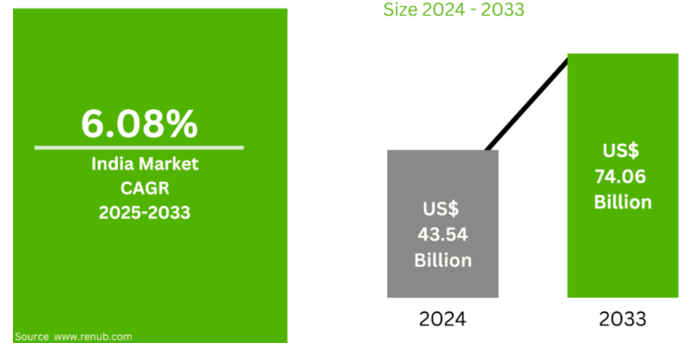
India’s fertilizer market is expected to expand from US$43.5 billion in 2024 to US$74 billion by 2033, growing at a healthy pace of around 6% CAGR. The drivers are clear:
- Feeding a growing population – With India’s headcount nearing 1.5 billion, boosting yields of staples like rice and wheat remains non-negotiable.
- Government support – Subsidies continue to anchor affordability, with fertilizer subsidies reaching ₹1.91 lakh crore (US$21 billion) in FY24.
- Soil nutrition needs – Intensive cultivation depletes soil faster, keeping demand for nitrogen, phosphorus, and potash steady.
- Emerging sustainability trends – Though still a small share, bio-fertilizers and balanced nutrient products are gaining traction, setting the stage for longer-term transformation.
Why it matters: These forces mean India’s fertilizer market is not just growing in size but also shifting in composition, with sustainability slowly moving from the margins to the mainstream.
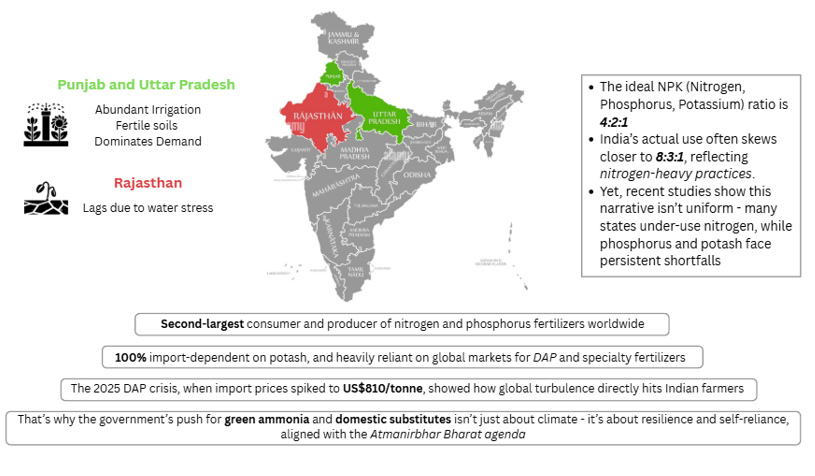
Regional Variations: Fertility and Imbalance
Types of Fertilizers in the Market Today: The Conventional Backbone
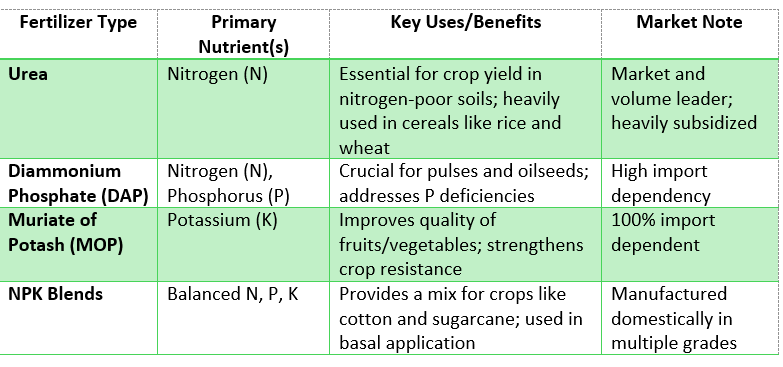
The Indian fertilizer market continues to be dominated by conventional chemical fertilizers, which account for over 95% of the commercial market. These remain the primary inputs sustaining Indian agriculture, largely due to their cost-effectiveness, government subsidies, and ability to deliver quick yield improvements.
Problems with Traditional Fertilizers: The Hidden Costs of Conventional Agriculture
Spotlight on New & Upcoming Fertilizers: Innovations for a Greener Future
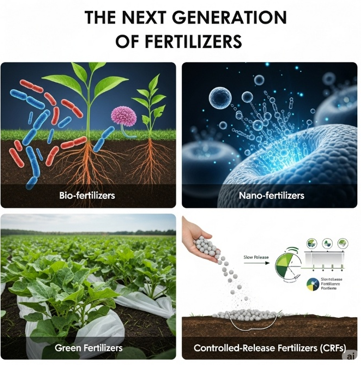
Bio-fertilizers
- Living formulations of bacteria, fungi, or algae (e.g., Rhizobium, Azotobacter, PSB).
- Fix atmospheric nitrogen, unlock bound nutrients, and enhance root health.
- Eco-friendly, low-cost, and regenerative for soil health.
Nano-fertilizers
- Nutrients packaged in ultra-small particles (<100 nanometers).
- Enable precise, slow, and efficient nutrient delivery.
- Reduce wastage, improve uptake, and boost yields.
- Notable launches: Nano Urea and Nano DAP, already scaling in India.
Green-fertilizers
- Produced with minimal carbon footprint.
- Example: Green Ammonia, made using renewable-powered electrolysis instead of fossil fuels.
- Potential to decarbonize one of the most emission-heavy industries—nitrogen fertilizer production.
Controlled-Release Fertilizers (CRFs)
- Engineered to release nutrients in sync with crop requirements.
- Polymer- or sulfur-coated to reduce leaching and volatilization.
- Serve as a bridge technology between conventional and next-gen fertilizers.
- India adoption already strong: ~76% share of CRFs in 2024 is polymer-coated variants.
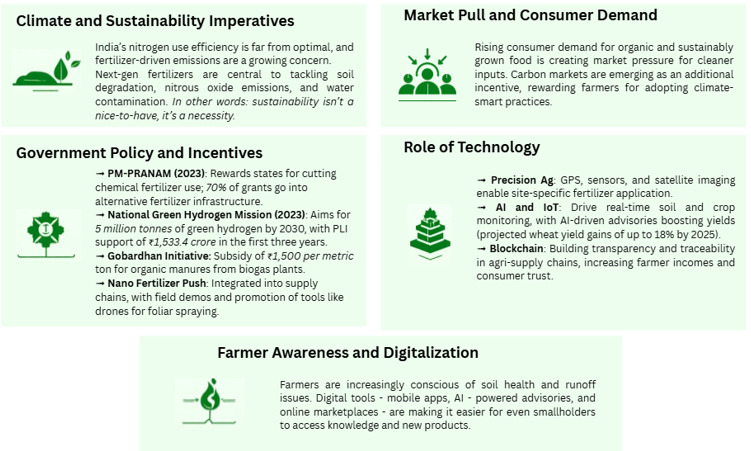
Key Drivers for Next-Gen Fertilizer Adoption
Benefits of Emerging Fertilizers: A Sustainable Harvest for India
Healthier Soils, Cleaner Waterways
- Restoring Soil Health
- Bio-fertilizers introduce beneficial microbes that fix nitrogen, unlock bound nutrients, and improve soil structure.
- Practices like water-fertilizer coupling enhance microbial diversity, increase soil enzyme activity, and restore long-term fertility.
- Reduced chemical dependence helps prevent acidification and micronutrient depletion.
- Protecting Water Resources
- Precision application from nano and controlled-release fertilizers cuts nutrient runoff and leaching.
- Minimizes risks of eutrophication and dead zones in water bodies.
- Example: Nano Urea reduces nutrient losses through leaching and emissions, making crop nutrition both cleaner and more efficient.
Increased Profitability for Farmers
- Lower Input Costs: A 500 ml bottle of Nano Urea can replace a full bag of conventional urea, reducing costs of purchase, transport, and storage.
- Higher Yields & Better Produce
- Field trials show yield gains of up to 8%, translating to ~₹2,000 additional income per acre.
- Crops grown with nano and bio-fertilizers also show better nutritional quality.
- Efficiency Over Time
- Controlled-release and precision delivery ensure nutrients are available when crops actually need them, which cuts down repeated applications, stabilizes yields, and reduces operational costs long term.
Enhanced Yields and Food Security
- Balanced nutrient management fosters resilient soils capable of sustaining high productivity.
- Crucial for feeding India’s growing population without further stressing land and water resources.
- Positions agriculture to shift from “yield at any cost” to yield with sustainability.
Strengthening India’s Global Position
- Adoption of bio, nano, and green fertilizers places India at the forefront of sustainable farming innovation.
- Rising global demand for environmentally conscious food creates export opportunities for India’s sustainably grown produce.
This creates a “win-win-win” — farmers earn more, the environment heals, and the economy gains new growth avenues.
Key Shifts Shaping India’s Fertilizer Market
Policy as a Market Architect
- PLI & Green Hydrogen → Incentives driving green ammonia and sustainable fertilizer production.
- SECI’s Tender → 724,000 tonnes of green ammonia annually, cutting imports and emissions.
- Import Reduction Wins → FY24 imports fell: Urea (-7%), DAP (-22%), NPKs (-21%).
- Smart Interventions → Neem-coated urea + PM-PRANAM rewards = more balanced fertilizer use.
Investment Shifts: Capital Goes Sustainable
- Established giants (Coromandel, Chambal, GSFC, NFL, RCF, Deepak, Zuari, Nagarjuna, FACT) still anchor the market.
- AgriTech boom → 10x growth in 3 years, fuelled by PE/VC bets.
- Winning edge = sustainability + digital tools (bio-fertilizers, organics, efficiency boosters, precision solutions).
Digital Transformation: Fertilizer Meets Tech
- AI-driven supply chains → Forecasting demand, cutting waste.
- Farmer apps → Personalized crop/fertilizer guidance (Kisan Suvidha, eNAM).
- Satellite & drones → Nutrient mapping, moisture tracking, precision spraying.
- Blockchain traceability → Authentic, trusted agri-exports.
- Big Watchout → Ensure tech doesn’t widen the gap between smallholders and large farmers.
Conclusion
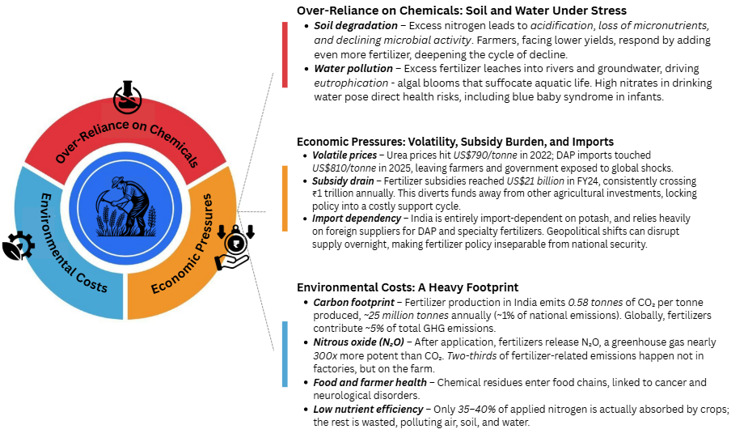
India’s fertilizer market in 2025 is not just expanding — it’s reinventing itself. Growth is still about feeding a growing population, but the real story is the sector’s pivot from volume to value: from chasing yields at any cost to pursuing efficiency, resilience, and sustainability. Traditional chemical fertilizers, once the backbone of Indian agriculture, now reveal their hidden costs — degraded soils, polluted water, a heavy subsidy bill, and a carbon footprint too large to ignore.
The future lies in bio, nano, and green fertilizers, powered by digital tools that make farming smarter and more precise. For farmers, this means healthier soils, better yields, and higher profitability. For investors, it opens a field of opportunity in R&D and agri-tech innovation. For policymakers, it’s a balancing act: driving productivity while ensuring inclusivity and environmental stewardship. If India gets this transition right, its fertilizer market won’t just grow — it will set a global benchmark for sustainable agriculture.